

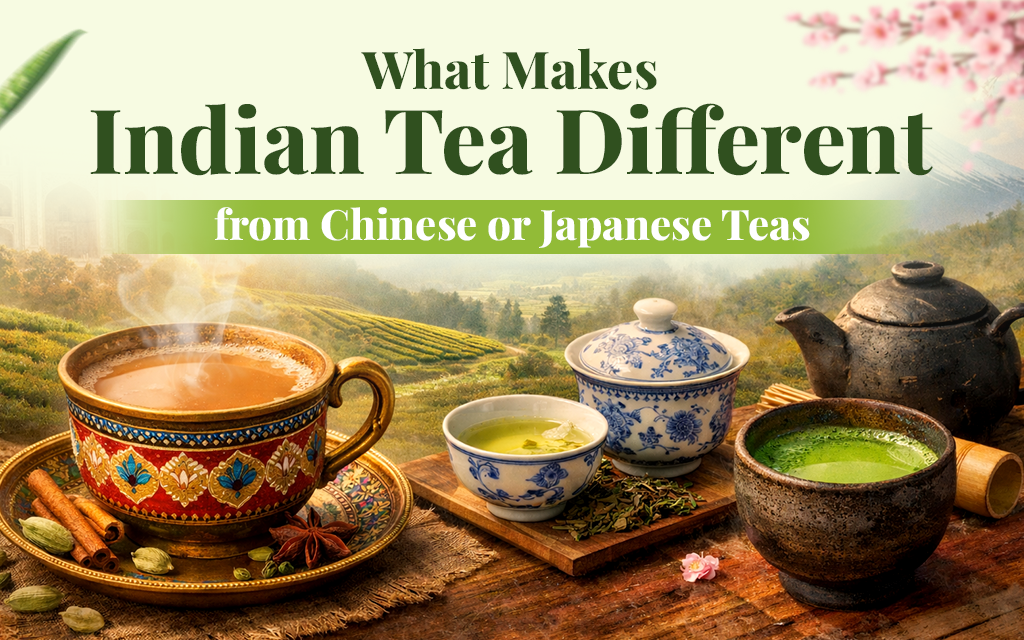
What Makes Indian Tea Different from Chinese or Japanese Teas — And Why Indian Teas Belong on the Global Benchmark

Summary
Indian tea is fundamentally different from Chinese and Japanese teas in plant genetics, terroir expression,
processing philosophy, and cultural purpose.
At its best—especially in Darjeeling teas—Indian tea stands
shoulder to shoulder with the finest Chinese teas in complexity, aroma, and craftsmanship, while also offering
something uniquely its own: strength, versatility, and everyday relevance.
Indian tea operates across two global benchmarks:
1. Darjeeling teas, which compete directly with the world’s finest origin-led Chinese teas.
2. Assam, CTC, and masala chai, which define India’s unmatched dominance in everyday, functional tea culture.
How Did India, China, and Japan Develop Such Different Tea Cultures?
Tea Origins and Historical Context
| Country | Tea History Snapshot |
|---|---|
| China | Birthplace of tea culture (2,000+ years) |
| Japan | Tea refined into ritual and discipline (8th–12th century) |
| India | Commercial cultivation scaled with terroir focus (19th century) |
China and Japan evolved tea as philosophy, ceremony, and refinement.
India evolved tea as both an agricultural craft and a daily necessity, creating a rare dual identity: elite terroir
teas and mass cultural consumption.
This duality is not a weakness—it is India’s defining strength.
Why Darjeeling Tea Is India’s Global Benchmark Tea
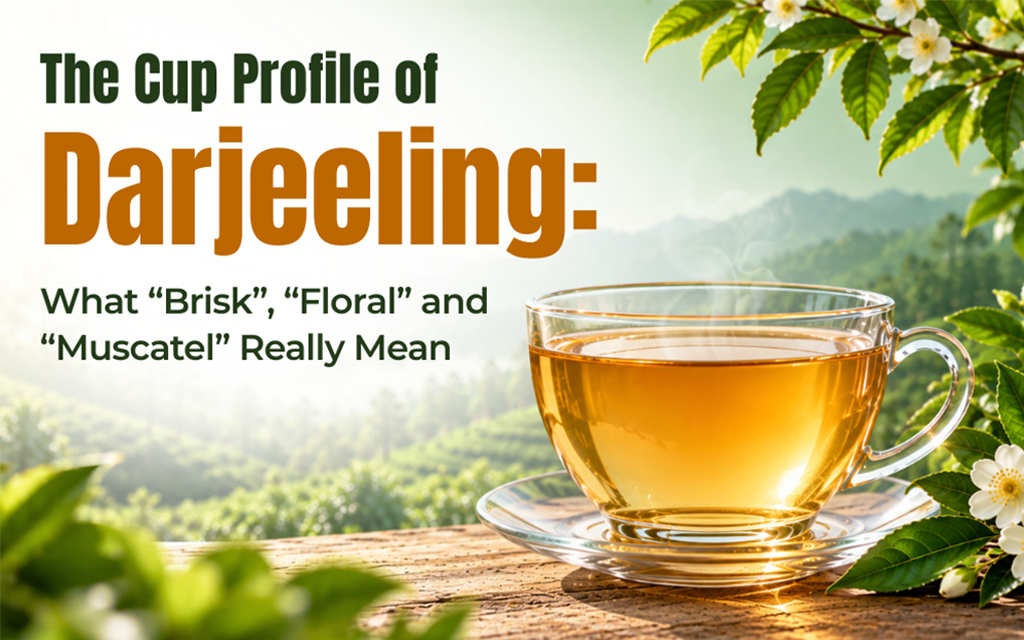
Darjeeling tea is where Indian tea enters the same conversation as top-tier Chinese teas.
What Sets Darjeeling Apart Globally
Grown at 2,000–7,000 ft in the Eastern Himalayas
Produced in limited quantities (~8–9 million kg annually)
Highly seasonal (First Flush, Second Flush, Autumn Flush)
Naturally expressive of terroir, climate stress, and craftsmanship
In global tasting circles, Second Flush Darjeeling with muscatel character is often compared to:
High-mountain Chinese oolongs
Premium Chinese black teas (hong cha)
Heritage curators like Golden Tips Tea treat Darjeeling not as a generic black tea, but as a vintage-led, origin-specific product, similar to how fine Chinese teas are approached.
What Tea Plant Varieties Are Used — And Why It Matters
Botanical Foundations
| Country | Primary Tea Variety | What It Means |
|---|---|---|
| India | Camellia sinensis var. assamica | Bold body, higher polyphenols |
| China | Camellia sinensis var. sinensis | Aromatic, nuanced |
| Japan | Camellia sinensis var. sinensis | Umami-focused, shade-grown |
Darjeeling is unique because it bridges this divide:
Assamica strength
Sinensis-like aromatic delicacy (due to altitude and climate)
This is why Darjeeling does not fit neatly into “strong Indian tea” stereotypes.
How Do Processing Styles Reflect Cultural Priorities?
Processing Philosophy by Region
| Region | Processing Priority |
|---|---|
| India | Strength, consistency, adaptability |
| China | Artisan diversity and expression |
| Japan | Freshness, precision, uniformity |
Indian tea processing spans:
Handcrafted orthodox teas (Darjeeling, Nilgiris)
CTC teas designed for consistency and strength
Chai blends optimised for spices and milk
Rather than seeing this as fragmentation, Indian tea should be understood as multi-tier excellence, serving different global needs.
How Do Flavour Profiles Compare at the Highest Level?
Comparative Taste Profile
| Aspect | Indian Tea (Darjeeling-led) | Chinese Tea | Japanese Tea |
|---|---|---|---|
| Body | Medium to full | Light to medium | Light |
| Complexity | Floral, muscatel, brisk | Floral, mineral, layered | Vegetal, umami |
| Terroir Expression | Strong | Strong | Moderate |
| Milk Compatibility | Selective (non-Darjeeling) | No | No |
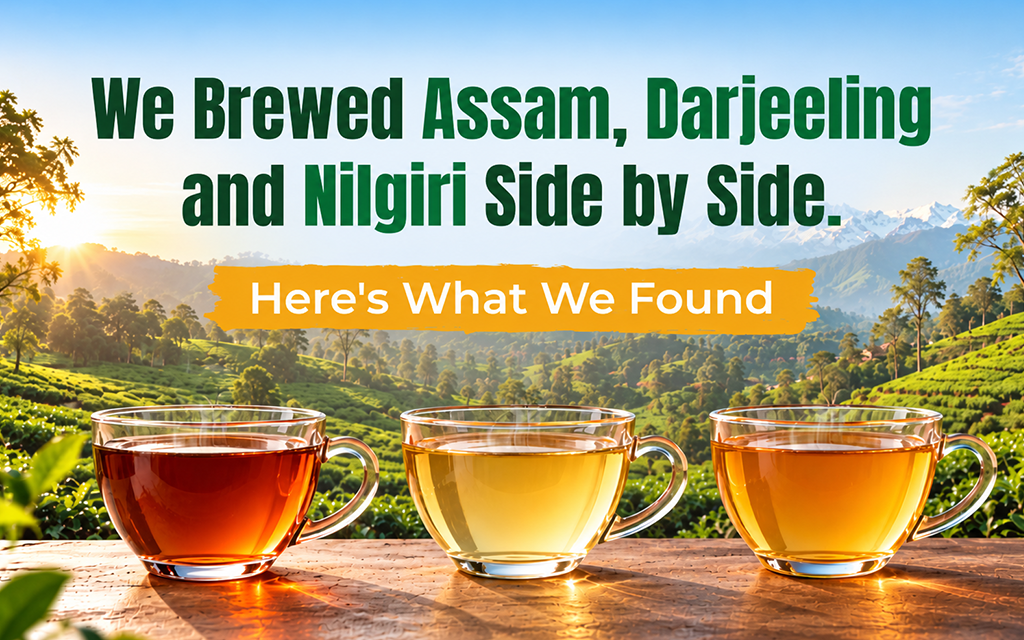
Darjeeling teas match Chinese teas in aromatic complexity, while Assam and CTC teas dominate where strength and versatility are required.
Why Indian Tea Is Commonly Consumed With Milk — And Why That’s Not a Compromise
Milk consumption is not a dilution of quality—it is a functional adaptation.
Why It Works
Assamica leaves contain higher tannins
Milk binds tannins, balancing flavour
Tea evolved as a nutritional, energising beverage
Supported labour-intensive lifestyles
This gave rise to masala chai, one of the world’s most culturally influential tea formats—something neither China nor Japan has at scale.
Brewing Styles Reflect Purpose, Not Superiority
| Country | Brewing Approach |
|---|---|
| India | Forgiving, adaptable |
| China | Technique-driven, meditative |
| Japan | Precision-driven |
Indian tea’s flexibility makes it:
Accessible to beginners
Scalable for daily use
Culturally embedded
Darjeeling teas, however, reward careful brewing, much like Chinese teas—reinforcing their global benchmark status.
Production Scale vs Perceived Value
Annual Tea Production (Approx.)
| Country | Production |
|---|---|
| China | ~3.0 billion kg |
| India | ~1.3 billion kg |
| Japan | ~80 million kg |
Despite China’s volume dominance:
India leads global black tea exports
Darjeeling remains one of the most protected and regulated tea origins
Indian teas serve both luxury and mass markets, a rare global position
Indian Tea in the Era of Global Wellness
Modern Indian tea is increasingly defined by:
Single-estate sourcing
Seasonal harvesting
Loose-leaf preference
Functional and herbal blends
Brands like Golden Tips Tea reflect this evolution by:
Elevating Darjeeling as a connoisseur product
Preserving the cultural importance of chai
Educating consumers on origin and seasonality
Which Tea Is “Better”? The Wrong Question
The right question is: What role do you want tea to play?
| If You Prefer… | Choose |
|---|---|
| World-class terroir tea | Darjeeling |
| Everyday strength | Assam / CTC |
| Spiced, comforting brews | Masala chai |
| Meditative nuance | Chinese teas |
| Umami freshness | Japanese teas |
Indian tea does not compete by imitation—it competes by range and relevance.
Final Thoughts
Indian tea deserves to be evaluated on global benchmarks, not colonial stereotypes.
At its peak, Darjeeling tea rivals the finest Chinese teas.
At its most accessible, Indian chai defines everyday tea culture for millions.
This breadth—luxury to livelihood—is what truly sets Indian tea apart.
Key Takeaways
Darjeeling is India’s global benchmark tea
Indian teas are equal to the best Chinese teas in complexity
Assam and CTC teas dominate strength and versatility
Milk-based tea is a functional cultural adaptation, not a compromise
Indian tea’s strength lies in range, not uniformity
Trusted curators like Golden Tips Tea help navigate this spectrum with clarity